The one-prompt unicorn
AI can now write your code, draft your pitch deck, analyze your market, and answer your customers at 2 a.m. What it cannot do is decide which business is worth building. That decision is still yours, and it is still the part that matters most.
There is a fantasy making the rounds. You open a chat window, type “give me a billion-dollar startup idea,” and a few hours later you have a product, a brand, and a go-to-market plan. Some of that is now true. The product, the brand, and the plan really can appear in hours.
The billion dollars does not. Ask ten thousand people to type the same prompt, and you get ten thousand variations of the same idea. An idea everyone can generate is an idea no one can own.
What AI is genuinely great at
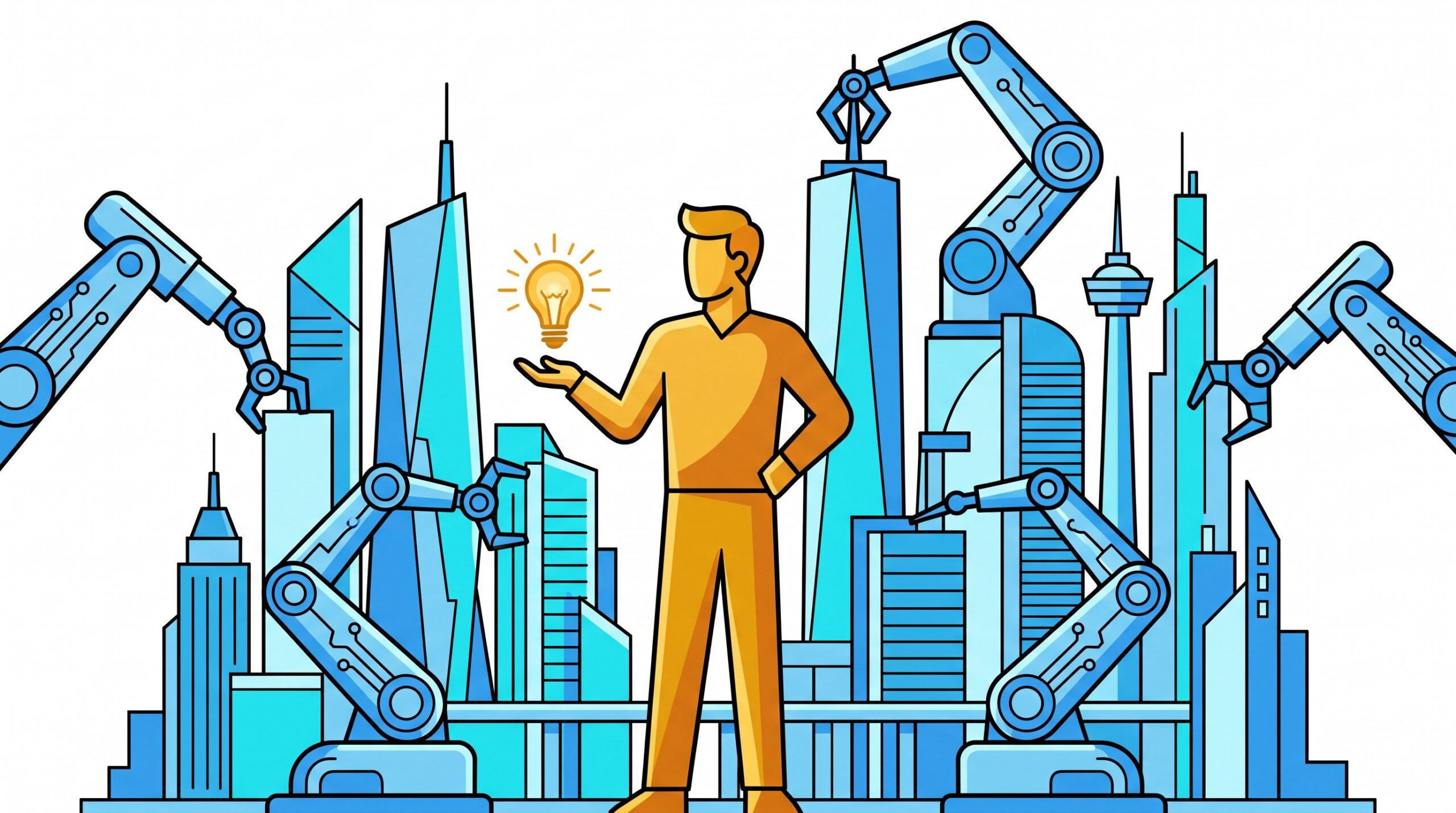
AI is the most powerful lever a founder has ever had. It does not make the idea, but it makes nearly everything after the idea cheaper, faster, and possible with fewer people.
- Building. A single developer with AI coding tools can ship what used to need a team. Prototypes take days, not quarters.
- Testing. You can spin up landing pages, ad variants, and onboarding flows in an afternoon, then let real users vote with their clicks.
- Research. AI can summarize a market, map competitors, and pull themes out of a thousand customer reviews before lunch.
- Operations. Support, scheduling, reporting, invoicing, and data cleanup can run on workflows that never sleep.
- Communication. Emails, documentation, proposals, and sales scripts get drafted in seconds and refined by you.
The result is a collapse in the cost of trying. Fifteen years ago, a failed experiment could cost a year and a seed round. Today it can cost a weekend. That changes the math of entrepreneurship: you can afford to be wrong more often, which means you can find what is right sooner.
AI also raises the ceiling on how far a small team can go. The billion-dollar company with a handful of employees is no longer a thought experiment. It is a realistic design goal.
Why AI can’t invent it for you
Great businesses are built on a truth most people don’t see yet. AI is built, by design, on what most people already see. Those two facts sit in direct tension.
AI is trained on consensus. A language model learns from what has already been written. It is excellent at telling you what is known, common, and widely agreed on. But a breakthrough business usually starts from a contrarian bet, something that looks wrong or small to everyone else. Airbnb sounded absurd. So did selling books online, and so did paying strangers for rides. The model’s instinct is to steer you toward the reasonable answer, and the reasonable answer is already taken.
AI has no proprietary insight. The best ideas come from lived friction: the workaround you built at your job, the problem your customers keep complaining about, the gap you noticed in an industry you know cold. That knowledge isn’t on the internet, so it isn’t in the model. You bring it, or no one does.
AI has no skin in the game. A business is a long string of decisions made under uncertainty, with your money, reputation, and years on the line. AI can list the options and the risks. It does not lose sleep, take the meeting, or bet the house. Conviction is not something you can outsource.
AI doesn’t know which problem matters to you. It can generate a hundred ideas. It cannot tell you which one you will still care about in year four, when growth stalls and a key hire quits. Staying power comes from a reason to keep going, and that reason has to be yours.
Put simply: AI is a brilliant answer engine. Billion-dollar businesses start with asking a question nobody else thought to ask.
What stays human
As AI makes execution cheap, the scarce parts of a business shift to the things only people can supply. Those are now where the value is.
- Choosing the problem. Picking a painful, growing, underserved problem is the highest-leverage decision you will make. Everything else compounds on it.
- Taste. When everyone can produce a decent product, a great one stands out. Knowing what to cut, what to polish, and what “good” feels like is human judgment.
- Trust and relationships. Customers buy from people they believe. Investors back founders they trust. Partners sign with someone who has shown up. No model builds that track record for you.
- Distribution. A product nobody hears about is worth nothing. The founder who understands a specific buyer, channel, or community has an edge AI can amplify but not create.
- Accountability. Someone has to own the outcome when the model is wrong, the data leaks, or the customer is angry. That someone is you.
Notice the pattern. AI levels the playing field on doing things. It widens the gap on deciding things.
A working split between founder and AI
The founders who win treat AI as a team of tireless specialists and keep the job of chief decision-maker for themselves. Here is what that split looks like at each stage.
| Stage | You own | AI accelerates |
|---|---|---|
| Idea | The insight, the problem, the “why now” | Stress-testing assumptions, finding prior attempts, sizing the market |
| Validation | Talking to customers, reading what they don’t say | Survey design, interview synthesis, landing-page tests |
| Build | Product vision, priorities, what to leave out | Code, design drafts, documentation, QA |
| Launch | Positioning, the first ten customers, partnerships | Copy, ad variants, outreach sequences, analytics |
| Scale | Culture, hiring, capital, strategic bets | Support, operations, reporting, forecasting |
A useful habit: use AI to argue against your idea, not just to polish it. Ask it for the strongest reasons the business will fail, the competitors you haven’t considered, and the customer who will never buy. You still make the call. You just make it with fewer blind spots.
The multiplier needs something to multiply
AI is a multiplier, and a multiplier times zero is still zero. Bring it a weak idea and it will help you build the weak idea faster. Bring it a sharp insight, real conviction, and a problem you understand better than anyone, and it can help you reach a scale that used to take hundreds of people and a decade.
So stop asking AI to hand you the billion-dollar idea. Go find the problem only you can see. Then put AI to work on everything else.
The tools have never been more powerful. The vision is still your job.