Almost every company now has AI. Very few have changed how they work because of it. That gap, not the model, is where AI transformations succeed or stall.
The numbers tell the story. In McKinsey’s 2026 State of AI survey, 80% of respondents say AI has made them personally more productive. Yet only 37% can point to any impact on EBIT, a share that has not moved in a year. The group McKinsey calls “AI high performers” (AI drives 5% or more of EBIT) is still stuck at about 6% of companies (McKinsey, Aug 2026).
So individuals are getting faster, and the enterprise is not getting better. After two decades of rolling out ERP, HRIS and workflow systems, I’ve seen this pattern before. A new tool lands on top of the old way of working, adoption gets measured in logins, and the business case quietly dies in a steering committee.
AI makes that pattern more visible, because the tool is so good on its own. Here are the seven challenges I see most often when companies try to move AI from a chat window into the daily flow of work, and what tends to fix them.
1. Bolting AI onto the old workflow
The most common mistake is treating AI as a faster pen. Teams hand a model the same five-step process they ran in 2019 and ask it to do step three quicker. Step three gets quicker. The process does not.
The data backs this up. Nearly three-quarters of McKinsey’s high performers say they have fundamentally redesigned workflows because of AI. Among everyone else, it is about one in four (McKinsey). Redesign, not tool choice, is what separates the two groups.
Redesign means asking different questions:
- Which handoffs exist only because a human had to re-key data between systems?
- Which approvals exist because nobody trusted the upstream step?
- If a draft costs nothing to produce, what should a person spend their time on instead?
- Where should a human review the output, and where is review just habit?
The practical test: if your AI project plan has no “future-state process map,” you are automating the past.
2. Fear, identity, and the frozen middle
People don’t resist software. They resist what the software says about their job. When a senior analyst watches a model draft in 30 seconds what took her a day, the question in her head isn’t “how do I prompt this?” It’s “what am I for now?”
That fear has a basis. In McKinsey’s 2026 survey, 39% of respondents expect AI to shrink their organization’s headcount in the next year, up from 32% (McKinsey). Employees read those headlines too.
The real bottleneck is usually middle management. Gallup’s Q2 2026 data shows a steep drop-off down the org chart in frequent AI use (Gallup, Jul 2026):
| Level | Use AI frequently, 2023 | Use AI frequently, 2026 |
|---|---|---|
| Leaders | 17% | 51% |
| Managers | 15% | 36% |
| Individual contributors | 9% | 26% |
Managers decide whether AI is “how we work here” or “a thing you can try on your own time.” Yet only 36% of employees strongly agree their manager actively supports AI use. Where they do, 78% use it frequently, versus 44% where they don’t (Gallup). Half of CHROs say they lack confidence in their managers’ ability to guide AI use (Gallup, Aug 2026).
The fix is not another lunch-and-learn. Give managers explicit permission, time, and a target: which tasks on their team change, and what people do with the hours they get back. Be honest about job impact. Silence gets filled with the worst-case rumor.
3. Messy data and processes that live in people’s heads
AI is only as good as what you feed it, and most companies feed it a scavenger hunt. Customer data sits in the CRM, the ERP, three spreadsheets and someone’s inbox. Field names mean different things in different departments. Nobody owns the master record.
Gartner predicts that through 2026, organizations will abandon 60% of AI projects that aren’t supported by AI-ready data. In the same research, 63% of organizations said they either lack, or aren’t sure they have, the data practices AI needs (Gartner).
The quieter problem is process debt. In every ERP implementation I’ve run, the documented process and the real process were different. The real one lived in the heads of two or three long-tenured people who knew which exceptions to approve and which vendor always invoiced wrong. An AI agent can’t learn tribal knowledge nobody has written down.
This is where business analysis earns its keep. Before you automate a workflow, map it as it actually runs, capture the exceptions, and name an owner for each data source the AI will touch. It’s unglamorous work, and it’s usually the difference between a demo and a production system.
4. Pilot purgatory and the ROI problem
Most companies are very good at starting AI pilots and very bad at finishing them. A pilot proves the model can do the task. It rarely proves the business will change because of it.
MIT’s NANDA initiative made this famous in 2025: in its GenAI Divide report, about 95% of enterprise generative AI pilots stalled without measurable P&L impact. The lead author’s diagnosis wasn’t model quality. It was a “learning gap” in how organizations integrate the tools (Computing). A year later, McKinsey’s EBIT numbers haven’t moved, and about one in five companies now say AI operating costs, including tokens, are limiting their use (McKinsey).
Pilots get stuck for predictable reasons:
- No baseline. Nobody measured cycle time or error rate before, so nobody can prove improvement after.
- Wrong metric. “Hours saved” is not a business outcome unless those hours go somewhere visible.
- No production owner. The innovation team built it; operations never agreed to run it.
- No kill criteria. Weak pilots linger and drain attention from strong ones.
Treat every pilot as a decision with a date. Define the baseline, the target, the owner who will run it in production, and the result that would make you stop. Killing a pilot on schedule is a success, not a failure.
5. Shadow AI and governance that says “no”
While leadership debates policy, employees have already decided. Deloitte’s 2026 GenAI Workforce Survey found that 31% of people using generative AI at work do so without their employer’s permission (Deloitte). The heaviest users of unapproved tools aren’t junior staff: in TrustedTech’s 2026 study, 65% of senior decision-makers used shadow AI, versus 31% of other employees (Help Net Security).
Shadow AI is a symptom. People route around official tools when the approved option is worse, slower, or doesn’t exist. The TrustedTech report puts it bluntly: that doesn’t change “until the sanctioned tools are genuinely worth using” (CSO Online).
In regulated industries, the stakes are higher. Client data pasted into a free chatbot is a compliance event, and “ban it” is the reflexive answer. Bans don’t stop use; they just stop you from seeing it.
Governance that works is an enabler, not a gate:
- Provide an approved tool that is at least as good as what people use at home.
- Classify data in plain language: what can go into AI, what can’t, and why.
- Make the review path for a new use case days, not months.
- Log and monitor usage so risk is visible instead of hidden.
6. Training that doesn’t stick
Most AI training teaches the tool. Few teach the job. A two-hour session on prompt basics, delivered once to the whole company, produces a burst of curiosity and then a return to old habits.
Access is still a problem. PwC’s 2026 Hopes and Fears survey of 49,364 workers found that only half say they can get the AI training they need, down from 59% the year before (The Next Web). But quality matters as much as access. In a 2026 LSE and Protiviti study, workers who found their training useful were 92% confident using AI. Those whose training wasn’t useful were 74% confident, barely above the 66% with no training at all (Protiviti).
In other words, bad training is almost the same as none. What sticks is role-specific and repeated:
- Teach on the team’s real work: their reports, their tickets, their month-end close.
- Build a library of proven prompts and workflows people can copy, not invent.
- Name AI champions inside each team, not just in IT.
- Revisit monthly, because the tools change faster than any annual curriculum.
7. Leadership that mandates but doesn’t lead
Many AI programs start with an executive memo: “Everyone should be using AI.” Then the work gets handed to IT or a single AI lead, with no budget for process change and no authority over the business units that own the workflows.
Employees notice. Gallup finds that three in four U.S. employees say their organization hasn’t communicated a clear AI plan (Gallup). Where a clear plan exists, engagement runs 15 points higher (Gallup). McKinsey’s high performers are twice as likely as others to say senior leaders are visibly committed to AI (McKinsey).
The other leadership failure is impatience. Executives expect results on a software timeline, but transformation runs on a change-management timeline. When month three doesn’t show savings, the program gets reset or the person leading it gets blamed, and the organization learns that AI is this year’s initiative rather than a new way of working.
Real sponsorship looks like this: a named business owner for each priority workflow, a budget that covers process redesign and training (not just licenses), leaders who use the tools in public, and a realistic 12 to 18 month horizon with milestones along the way.
What actually works
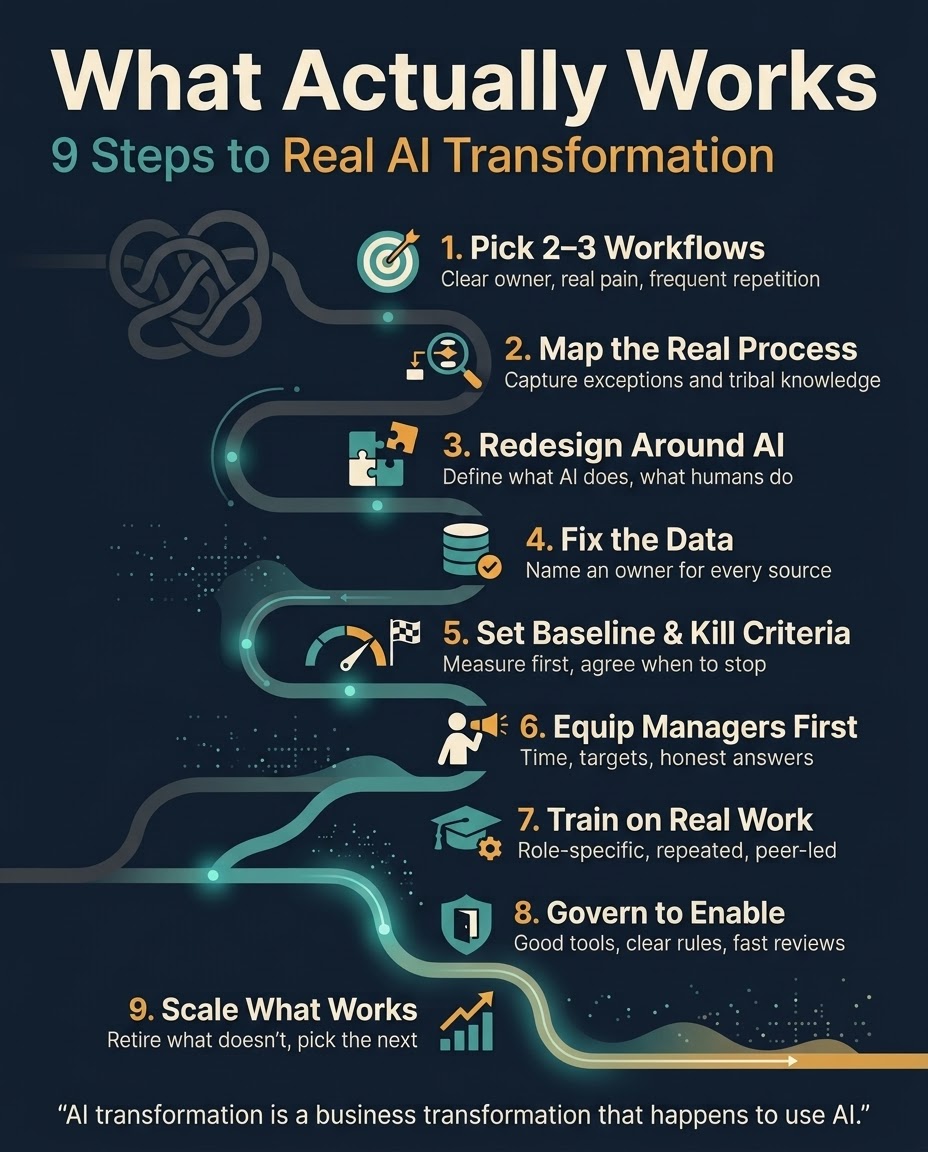
None of these challenges is technical, and that’s the good news. They respond to the same disciplines that have always made enterprise change stick. Here’s the sequence I’d follow:
- Pick two or three workflows, not twenty use cases. Choose ones with a clear owner, measurable pain, and frequent repetition.
- Map the work as it really runs. Capture the exceptions, handoffs and tribal knowledge before touching a tool.
- Redesign the workflow around AI. Decide what the model does, what the human does, and where review is required.
- Fix the data the workflow depends on. Name an owner for each source; clean only what this workflow needs.
- Set a baseline and kill criteria. Measure before you start, and agree on what result would end the pilot.
- Equip managers first. Give them time, a target, and honest answers about job impact.
- Train on real work, then repeat. Role-specific sessions, shared prompt libraries, and team champions.
- Govern to enable. Approve a good tool, publish plain-language data rules, and keep the review path short.
- Scale what works, retire what doesn’t. Move proven workflows into operations with a production owner, then pick the next ones.
The companies pulling ahead aren’t the ones with the best models. Everyone has access to roughly the same models. They’re the ones willing to change how the work is done, and patient enough to bring their people with them.
AI transformation is a business transformation that happens to use AI. Treat it that way, and the technology becomes the easy part.
Sources
- The state of AI in 2026: On the road to ROI — McKinsey, Aug 2026
- AI and workplace productivity — Gallup, Jul 2026
- AI’s effect on workplace culture — Gallup, Aug 2026
- Employee engagement remains flat as AI adoption accelerates — Gallup, 2026
- Gallup AI Indicator — Gallup, 2026
- Lack of AI-ready data puts AI projects at risk — Gartner, Feb 2025
- MIT report: 95% of corporate generative AI pilots fail to deliver returns — Computing, 2025
- GenAI Workforce Survey: Shadow AI — Deloitte, 2026
- Turns out the C-suite loves shadow AI — Help Net Security, May 2026
- Senior executives are killing your shadow AI strategy — CSO Online, 2026
- PwC survey of 49,000 workers finds most are falling behind on AI skills — The Next Web, 2026
- LSE generational survey report — Protiviti, 2026