
Two Kinds of Distance
Every AI initiative starts with a distance between where your organization is today and where the technology could take it. Some of that distance is a gap. Some of it is a chasm. Knowing which is which decides whether your investment compounds or quietly disappears.
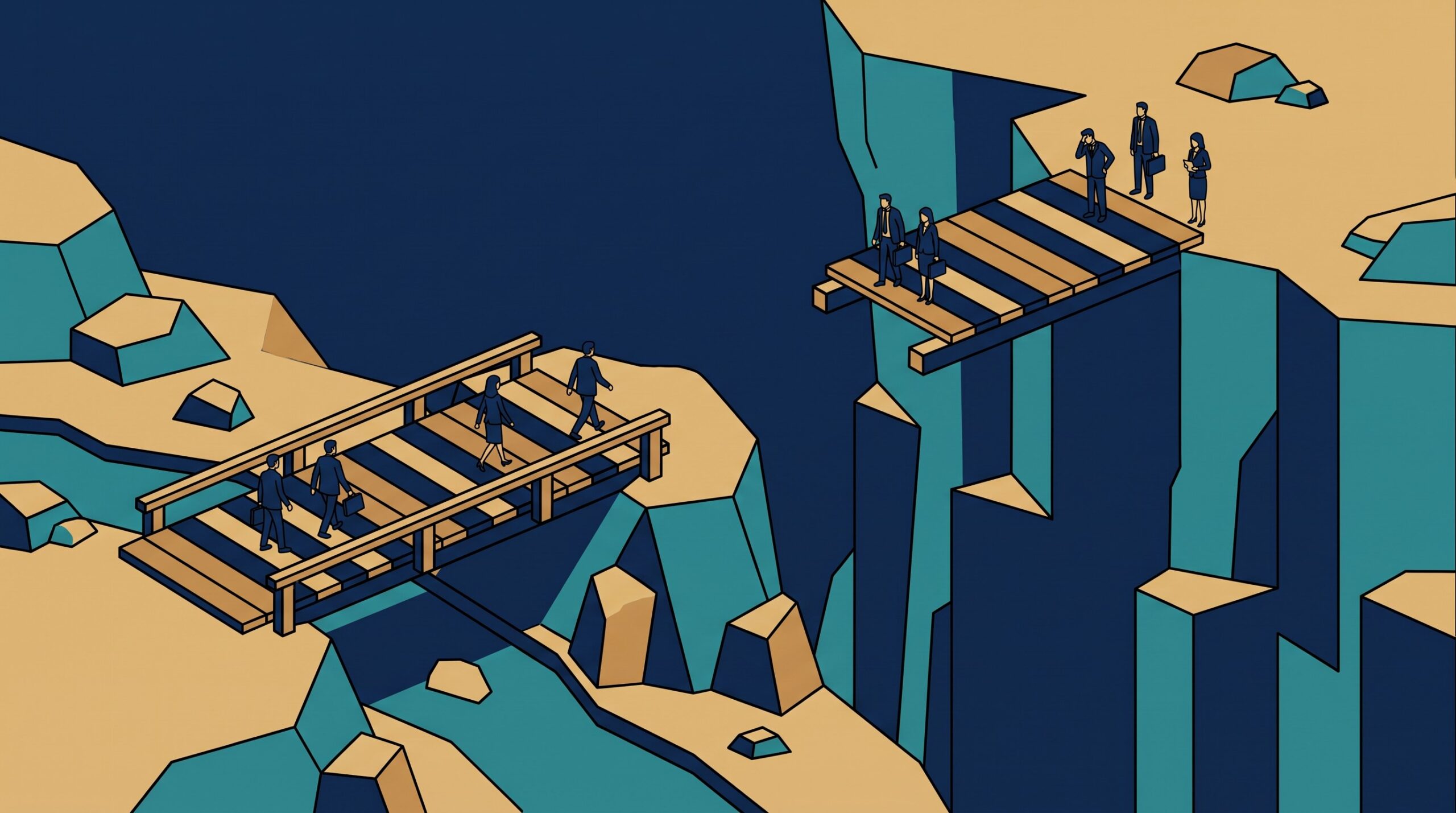
A gap is distance you can close. It costs time, money and patience, but it has a far side you can reach. A chasm is different. It is a hard constraint that no amount of training, tooling or enthusiasm will get you across.
Most stalled AI programs did not fail because leaders under-invested. They failed because leaders spent bridge money on a chasm.
What a Gap Looks Like
A gap is a shortfall in something you control. It is uncomfortable, but it answers to effort. The most common ones are familiar:
- Skills. People don’t know how to prompt, review or trust AI output yet.
- Tools. The right platform isn’t licensed, configured or connected to your systems.
- Process. Workflows were designed for humans handing paper to humans.
- Data quality. The data exists and you’re allowed to use it, but it’s messy, duplicated or scattered.
- Habits. Teams default to the old way because the old way is familiar.
Consider a composite example. A mid-sized distribution company wants AI to draft responses to customer service tickets. Early results are poor. Agents ignore the drafts, the knowledge base is out of date, and nobody owns the prompts.
Every one of those problems is a gap. Clean up the knowledge base. Assign an owner. Run four weeks of hands-on training. Measure draft acceptance weekly. Within a quarter the team is using the tool because it finally saves them time.
Gaps share one trait: the path across is visible from where you stand. You may not like the cost, but you can price it.
What a Chasm Looks Like
A chasm is a constraint you do not control and cannot spend your way past. It does not shrink with training. It does not move when the vendor ships a new release. It stops adoption dead.
- Regulation. A rule says a licensed human must make the decision, or that certain records cannot leave a defined boundary.
- Liability. Nobody in the organization is willing, or allowed, to sign for an AI-assisted outcome.
- Forbidden data. The data that would make the use case work is data you are not permitted to use for this purpose.
- Incentives. The people whose work changes are paid, promoted or protected by the old way, and they hold the veto.
- The business model. The efficiency AI creates erodes the very thing you bill for.
Consider a second composite. A professional services firm wants AI to produce first drafts of client deliverables. The pilot works. The drafts are good. Then the project halts.
The firm bills by the hour. A draft that once took twelve billable hours now takes two. Partners see revenue walking out the door, clients have not agreed to new pricing, and no one has the authority to change the model. Better prompts will not fix that. Neither will more training.
That is a chasm. The far side exists, but there is no bridge from here.
Why Leaders Confuse the Two
Chasms disguise themselves as gaps. From the executive floor, both show up the same way: low usage, slow pilots, disappointing ROI. The symptom is identical, so the prescription usually is too.
The default prescription is a bridge. More training. A better tool. A change management campaign. An AI champion in every department. These are good investments when the problem is a gap. Pointed at a chasm, they fail and leave damage behind.
The damage compounds. Employees conclude that leadership doesn’t understand the real obstacle. The AI team burns credibility on a use case that was never viable. The budget for the next initiative shrinks. Worst of all, the organization learns the wrong lesson: that AI doesn’t work here.
It worked fine. You just asked it to cross terrain that had no crossing.
How to Tell Which One You Face
The test is simple: would the obstacle disappear if you had unlimited time, money and goodwill? If yes, it’s a gap. If no, it’s a chasm. Before funding the next push, put these questions to your team.
| Question | Sounds like a gap | Sounds like a chasm |
|---|---|---|
| Who owns the obstacle? | Someone inside the organization | A regulator, a contract or a client |
| What would fix it? | Training, tooling, cleanup or time | A change in law, pricing or authority |
| Who loses if AI succeeds? | Nobody, or only the old habit | People who hold the veto |
| Can we use the data? | Yes, once it’s cleaned up | No, not for this purpose |
| Who signs for the outcome? | A named leader, today | No one can, or no one will |
Ask these before the pilot, not after it stalls. An hour of honest diagnosis costs less than a quarter of failed adoption.
What to Do at the Edge of a Chasm
You don’t bridge a chasm. You stop, name it, and choose different ground. That takes discipline, because stopping feels like failure and leaders are paid to push through.
- Stop funding the bridge. Pull the training budget and the tooling spend from that use case. Every dollar more teaches the organization that AI doesn’t work.
- Name the chasm out loud. Tell the team exactly what the constraint is and that it isn’t their fault. Credibility comes back the moment people hear leadership see the real obstacle.
- Reroute to ground where AI can win. Most organizations have dozens of use cases sitting on the near side of every chasm. Internal reporting, research, onboarding, document review: find the work with no regulator, no veto and no billing conflict.
- Escalate what only strategy can change. If the chasm is a pricing model or an authority structure, it isn’t an adoption problem. It’s a board-level decision, and it belongs on that agenda, not in a pilot.
The professional services firm from earlier never got AI drafting into client work. It put AI into proposals, internal research and staff onboarding instead, where hours saved were pure margin. Adoption took off.
Gaps reward persistence. Chasms punish it. The best AI leaders aren’t the ones who never stall. They’re the ones who know, early, which kind of distance they’re looking at.